
In 1969 Bob Gibson started 35 games with 28 complete games and a total of 314 innings pitched. Comparisons to Bob Gibson to today’s starting pitchers would be silly.
So lets look at Washington Senators pitcher Joe Coleman who started 36 games (plus 4 in relief) and pitched 12 complete games and pitched 247⅔ innings. In 2025 there were a total of 29 complete games and the most innings pitched by a single starter was Logan Webb (207 IP) and only two other starters had at least 200 innings: Garrett Crochet (205⅓ IP) and Cristopher Sánchez (202 IP).
Baseball has evolved over time and perhaps we will see an evolution of the concept of starting pitchers. Will we see some variant of tandem pitchers in the future? The idea is you pair two pitchers who can pitch multiple innings before handing it off to the bullpen.
Matt Borgschulte was recently rumored to be the Nats new hitting coach. He supposedly has said his analytics folks did simulation models for how to approach hitting. So, whoa DUH, it occurred to me that it was possible to simulate the viability of various approaches to tandem pitchers.
As an analytics person, I have my question to analyze: Is the concept of tandem starters even feasible.
So the next step was I needed to get data on the distribution of how many innings a typical starter throws. 2022 was the last year that I was able to download the game day data so I used that data to get the distribution. The image below shows the distribution for the over 4,800 starts. Now some disclaimers:
- Yes, this data is somewhat dated.
- It does include games where the starter was an opener. Based on a quick query, that is likely less than 100. So they were kept to (slightly) bias the percentages towards fewer innings pitched.
- This data is limited to starters. It does not include what used to be call long men (relievers who could go multiple innings).
My bottom line is that this data is good enough for an initial rough cut analysis.
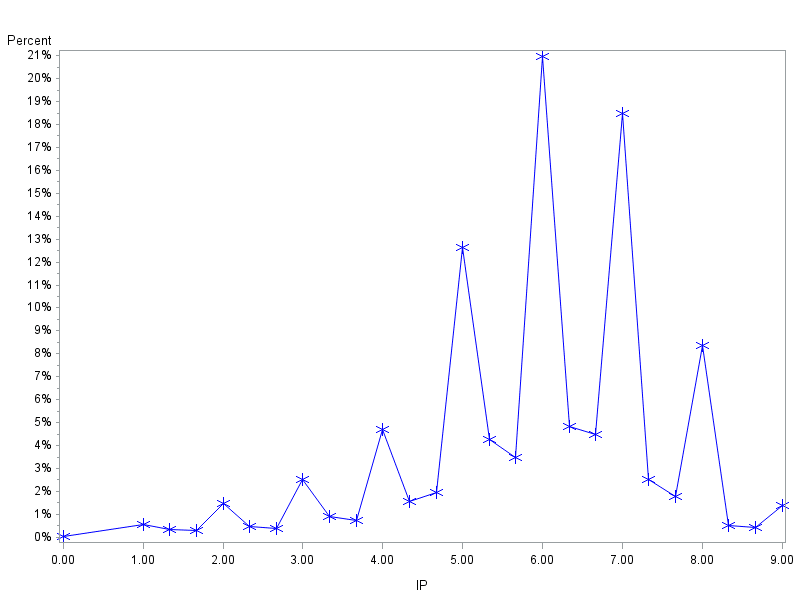
As expected, the data shows spikes at inning changes (though admittedly they include games where the starter got no outs in the inning).
There are likely countably infinite number of variations for how to approach the idea of tandem starters. I decided to start simple and discuss with Steve and Andrew here, and hopefully lots of suggestions in the comments for ideas. The issue is that each variation requires a different software program to simulate it. Starting with the simplest version to start a discussion is what I decided.
For this simple case I have 10 tandem starters to just assess viability. I ran a million simulations of the following:
- Using the distribution of data in the above chart I used a random number generator to pick a number of innings pitched for the first starter in my tandem.
- Assuming that was not 9 innings, I used the same distribution to pick a number of innings pitched by the second starter.
- If the innings added up to 9 or more, I shortened the innings pitched by the second guy to total 9 and assigned 0 inning pitched to the bullpen.
- Otherwise if the two starters did not complete 9 innings, the difference was applied to the bullpen.
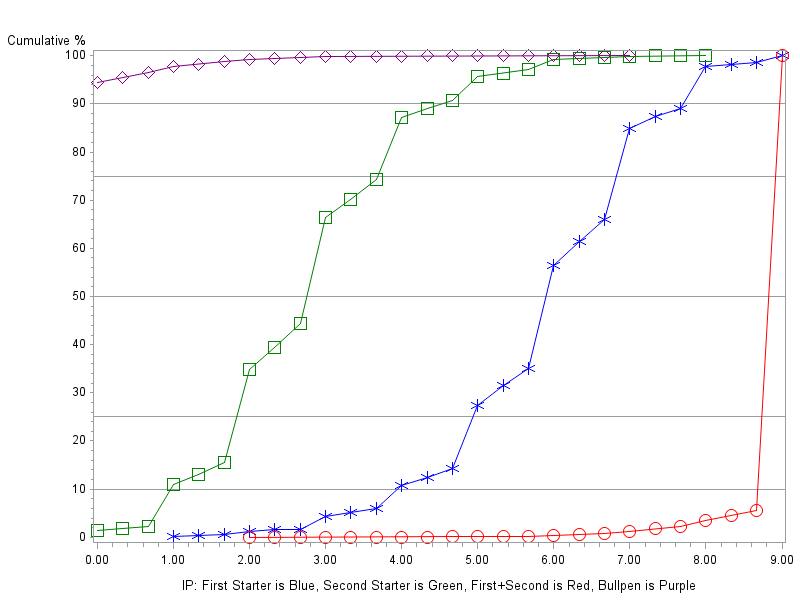
The cumulative plot below shows the results. Also note that there are reference lines drawn at 10%, 25%, 50%, 75%, and 90%.
Some points to help clarify how to interpret the graph:
- Looking a 6 IP, roughly 50% of the time that first starter finished the 5th inning and the second starter covered close to the rest of the time.
- Looking at the BP line (purple), roughly 95% of the time no BP innings were needed and the probability of needing more than 2 BP innings is pretty low.
- The combined innings of the first and second tandem starter has a spike at 9 innings. This dovetails with the point about how often the two tandem starters cover all 9 innings.
Let’s Discuss
Don: Again, let me emphasize that this was just to test the basic idea. And the simulation seems to do that. But we know that 10 tandem starters is not an option. So what variations should we consider. It could include:
- How many tandem starters?
- If the first tandem starter goes at least X innings, do we go straight to the bullpen (and save the second tandem starter for the next game)? And what is a reasonable value for X?
- If the first tandem starter does not complete an inning and has not gone X innings, do we use a bullpen guy to finish the inning and bring in the second tandem starter for a clean inning?
- Do we almost always give the 9th inning to our closer?
- And so on, and so on.
Steve: The Nats had an opportunity to try this with both Michael Soroka and Trevor Williams. Soroka was an effective short starter in 2025 and Williams in 2024. Both got iffy after the third and fourth innings. While it is not optimal to have two pitchers like that, would it work to have two tandem long-men relievers assigned to each starter? That would leave just six relievers to cover 16-17 innings through a 5-man rotation. That’s a lot of innings to cover.
Andrew: I think if you can shuffle in some fresh arms, maybe that could work because there is a larger burden on the bullpen if you have more than one tandem starter. It seems like having one tandem starting duo could work. By doing that you ask your bullpen to pitch another 60 innings. With more relievers who can pitch length this could be doable.
Don: Pairing Soroka and Williams is a good example. My view would be that you combine them as the tandem starters. They could alternate who starts.
My initial idea for what to simulate was more complicated than what I described above. This approach was just to generate discussion about options. For example, could you have 7 (or 8) guys who are tandem starters and if the guy who starts the game goes 5 (or 6) innings you use the bullpen for the remaining innings and then the second guy starts the next game with the guy behind him ready to go if needed. The nuance there is how many times would your first guy not pitch enough innings and the next guy up is on short rest. That is something that can be factored in to the simulation model and the innings for starters and bullpen summarized similar to the above.
Steve: Need to look at what is reasonable for bullpen innings in a season. Take the Nats 2025 bullpen innings and can they absorb another 60 innings? I think the game has to evolve to more long men would be my answer.’
Don: WRT the question how many extra innings this means for the BP, it is not a given that it is not less innings. That is something to look at. In this simulation using the percentage of bullpen innings times 162 games times 9 innings to convert the percentage to innings in a 162 game season, the result is a total of 103 BP innings. Obviously, a tiny number because every game is two starters or two long men to use that term. What you call long men and what i call tandem starters are very similar.
The next simulation would actually be simulating a 162 game season instead of a million games. And it would not be 10 tandem starters. Doing just a million games simplified this first cut.
Steve: I am open to this. I really thought that Soroka would have benefited from a tandem duo.
Andrew: I’m open to this also if needed.
Wrap Up
There are lots of options to consider for how to do the next simulation. The results here convinced me that some form of tandem pitchers is practical.
The major change I will be making in a future simulation is to factor in the game schedule. That was not needed here with 10 tandem guys since you would not have any of them going on short rest. Factoring in the game schedule is important if you have, say 7 or 8, tandem starters, and you only use your next tandem guy to finish a game if the first guy did not go 5 or 6 innings. The possibility that your next guy up (as either the first or second pitcher in a game) might have pitched less than 5 days ag0.
The discussion here regarding Michael Soroka and Trevor Williams makes me think that maybe the next simulation is 2 tandem guys, 4 regular starters and a 7 man bullpen. That can be done without regard to the schedule since all the starters would go on regular rest. Such a simulation would be just a minor tweak to the current application in that simulating games instead of a season is an option. I would, however, need to be creative with the distribution of innings pitched. Maybe take the same data and chop off anything more that 6 innings pitched and recalculate the percentages.
 talkdcsports-kzeim
Leave a comment