
In the article, The Evolution of Pitching Roles, we discussed how the role of starting pitchers has changed over the years. We did a simulation by pairing 10 starters, two per game, to see the impact on starter and bullpen innings. The results indicated it could be a viable approach. Of course, the idea that a team could have 10 legitimate starters makes that a non-starter.
This article will revisit the basic idea. A thousand simulations of a 162 game season (i.e., 162,000 games) were run with the assumption of 7 available starters. The basic idea is that the starters are managed as a FIFO stack. A list of 7 pitchers is maintained, along with when they are available to pitch, assuming 4 days of rest since the last time they pitched. This restriction of 4 rest days is why this simulation is of 1000 iterations of 162 game seasons, instead of just simulating games. The previous study had 5 pairs to 2 starters, so there was not an issue with the number of days of rest.
Two sets of data drive the simulation. The first is the distribution of how many innings a starter can pitch. The second is the Nationals 2026 schedule. Using a real schedule enables to simulation to take advantage of off days in pitcher usage. The logic is similar to the previous simulation with the constraint that a starter can only be used if it has been at least 5 days since he last pitched:
- If a starter is available, use the probability distribution to determine how many innings he can pitch and 5 days are added to the date for the current game to indicate when he is available to pitch again.
- If no starters are available, all the innings are assigned to the bullpen and we move on to the next game.
- If the starter does not complete 5 innings and the next pitcher in the stack is available with 4 days rest, we use the same probability distribution to determine how many innings he can pitch (truncated if the total adds to more than 9). He next available date is updated to 5 days from the date for the current game.
- If there isn’t a second starter available, all the remining innings are assigned to the bullpen.
- If the total innings for the current game pitched by the two starters is less than 9, the balance of the innings are assinged to the bullpen.
- Move on to the next game in the schedule.
At some point in the not too distant future some team will reinvent how pitchers are used. Why not this year given that the Nationals have more than a few pitchers who are legitimate back of the rotation pitchers and no more than 1 or 2 (if that many) front of the rotation pitchers?
Per Roster Resource, the Nats have 8 candidates, not counting any (hopefully) FA starter signings: MacKenzie Gore, Cade Cavalli, Brad Lord, Josiah Gray, Foster Griffin, Jake Irvin, Mitchell Parker, Andrew Alvarez. Instead of moving 3 (or more) of these guys to the Bullpen or to Triple-A, why not try stacking 7 of them as described above as starters; with 1 or more sent to the minors (they all have options left).
Steve: This could work if anyone was willing to try it. The issue is the breakdown of ineffectiveness where the pitcher can’t make it out of their first inning.
Andrew: Those crazy unexpected short games or something like an injury would be devastating to this scenario.
Don: Not getting out of the first inning does happen rarely. The data I used to create the distribution of innings pitched shows it occurs about 1.2% of the time. As a result of that, such games are factored into the simulations.
The typical concern with having more that 5 starters is the impact on the bullpen. With 7 stacked starters, the bullpen is reduced to 6 from 8. That leads me to focus on bullpen innings in the simulation. Before getting into the aggregate summary of the 1000 simulations of a season, the following graph that shows bull pen innings vs. date highlights some key points.
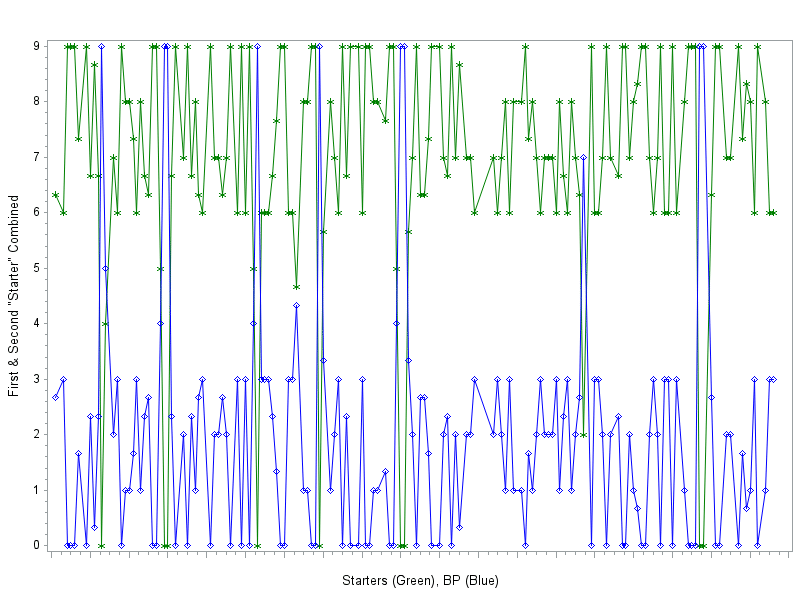
The blue lines represent the combined innings of the combined first, and if needed, second starter. You can see that the majority of the time the bullpen throws less than three innings. There are 7 game dates where either the starters were not available or failed to get out of the first inning. With this perspective, let us look at the distribution of bullpen innings averaged by date over the 1000 simulations.

This graph reinforces the idea that stacked starters do not stress the bullpen. Managing bullpen load is not that simple. If you stress the bullpen one day, you are limited the next day. To investigate that the following graph should the 3 day moving total of bullpen innings pitched (i.e., current days game plus the games, if any from the previous two days).

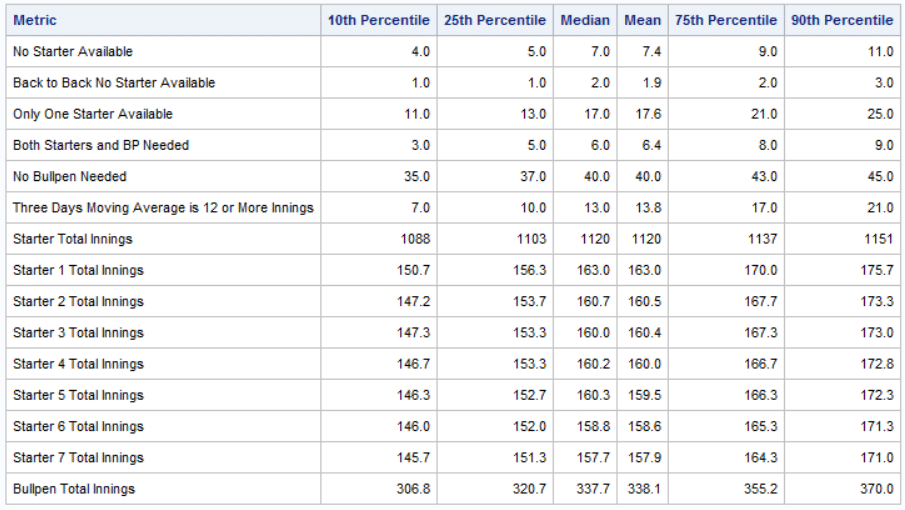
The blue line (the median) indicates that half the time, the bullpen pitches 6 innings or less over the rolling three day period. The red line (the 75th percentile) indicates that, with just a few exceptions, 75% of the time the bullpen throws less that 9/10 innings. With this perspective lets look at a table of metrics. The green line also illustrates one quirk of using the same schedule for all 1000 iterations – the first game after the All-Star break will always have a 3 day running total of 0.
In my opinion, nothing here indicates that having 7 stacked starters will break the bullpen. YMMV.
Steve: This could certainly be something to look at especially with all of the long-men and extra starters that you might have.
Andrew: Baseball is slow to evolve. This seems like something Tampa would do.
Don: And to the skeptics out there who properly say the graphs ignore the 40+ games corresponding to the games above the 75th percentile. The following two graphs are much busier as they include the 10th and 90th percentiles. This first graph is bullpen innings and as expected there is lots of variation above the 75th percentile. But again, probably managagle.

This next graph is the 3 day moving total and illustrates that there are times when the bullpen is stressed. That happens with 5 starters and an 8 man bullpen so it is not suprising that it happens with 7 stacked starters and a 6 man bullpen. Calling guys up from the minors is the approach to either of these.

Steve: I like the data and almost predictable patterns. Again, the issue is when the unexpected happens.
Andrew: Can you go with 2 starters in a game and have them go for just the 2 of them to finish a game. On the road where you are losing, it is an 8 inning game. Both pitch 4 innings and you save the bullpen.
Don: That is very similar to what this simulation did. There are lots of variations that a team could consider. In the article mentioned above (The Evolution of Pitching Roles), a request was made to limit the number of innings the tandem starters could pitch to 6 complete innings. And the point was also made that teams will want their closer in close games. The analysis was repeated with the restriction on total innings a tandem starter could pitch and a random number generator was used so 2 out of every 3 games (an over-estimate) had a bullpen inning for a closer. The metrics table along with the bullpen innings and moving total graphs with the 25th, 50th and 75th percentile follow.
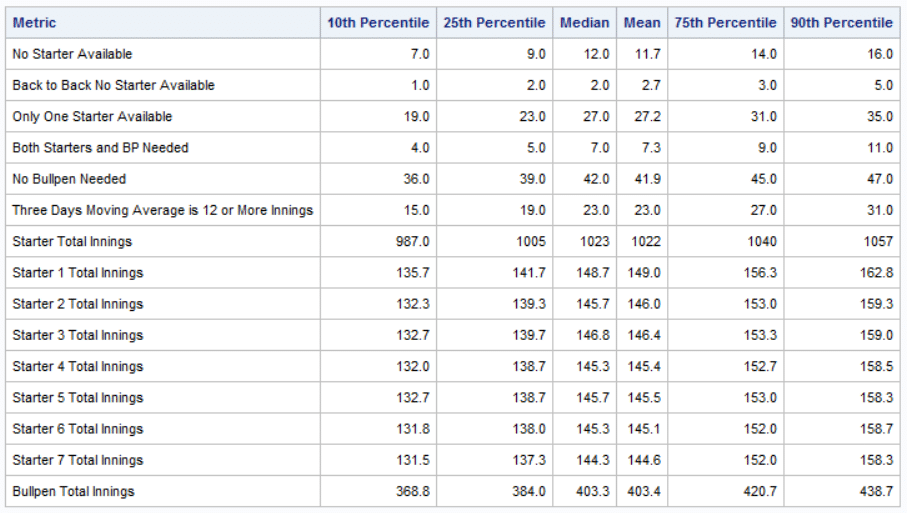
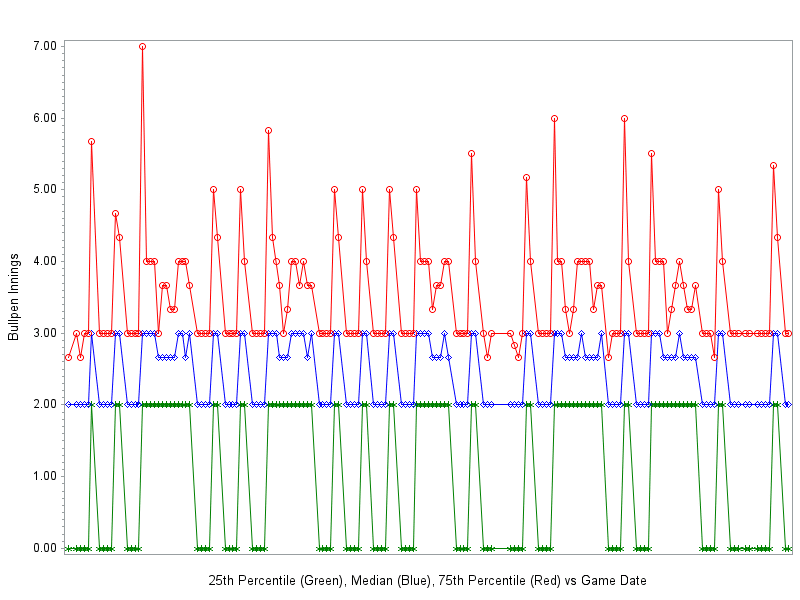
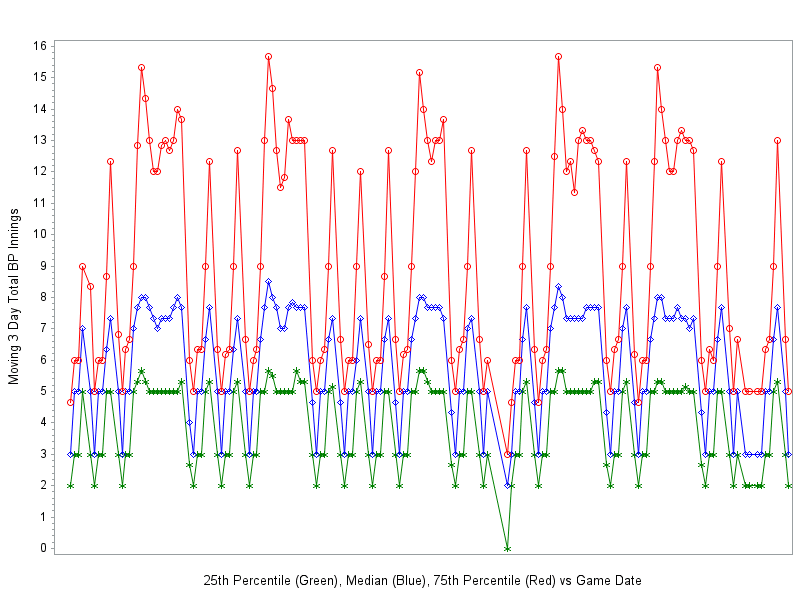
The table and the graphs show more bullpen innings and the percentiles are more compressed. Again, IMO nothing here suggests that 7 stacked starters is not viable. YMMV.
Steve: I think you have made a viable case with the right personnel that it could work. Really good analysis Don!
Andrew: I agree with that. Don is amazing at these projects.
Don: Thanks for the kind words. I enjoy doing such projects. For those of us whose age is up there, it keeps you sharp.
Wrap-Up
Don: The simulation described above made a number of simplifying assumptions (e.g., every starter has the same innings pitched profile). Along those lines, it did not order the stacked starters optimally based on their profile. The point was to simply ascertain if the concept of tandem starters (in this case 7) was viable.
At some point teams are going to adjust to the new world of starters throwing harder and not going as deep. Whether that is tandem starters is a Who Knows? question. I hope some team tries it, uses more appropriate innings pitched distributions, factors in being able to call up starters when none are available or call up bullpen pitchers when needed. Just as teams do in todays game.
I do have to add a disclaimer. The programming code for these simulations was not overly complex. But folks writing programs make mistakes. And mistakes are typically found by co-workers who review your work. Since I am long-retired, I don’t have the benefit of someone in the next office/cubicle to review. I feel confident that the code is correct because I managed the development over a long time period with breaks in between. When I began work again, I had fresh eyes looking at it.
Steve: I would have loved this last year with Michael Soroka and Mitchell Parker going righty/lefty in a tandem. Maybe MacKenzie Gore gives you 5.0 innings and you go right to Jackson Rutledge for 2+ innings.
Andrew: Certainly with Soroka. You really nailed who he was when he was signed last year that he was a 3-4 innings short starter.
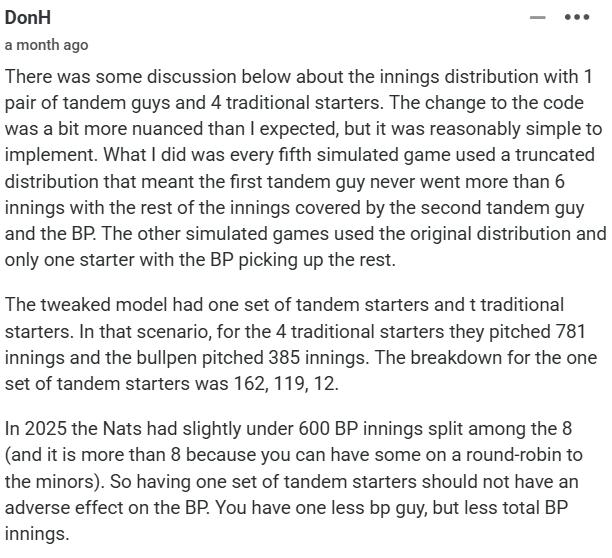
Don: The idea of pairing Soroka and Parker that we discussed this past season was what gave me the idea of tandem starters, including the lefty/righty approach you mentioned. In fact, in this comment on the prior article I responded with the following to a question about just one pair of tandem starters that is very similar to what you are suggesting.
Now it is your turn to weigh in.
 talkdcsports-kzeim
Leave a comment